

























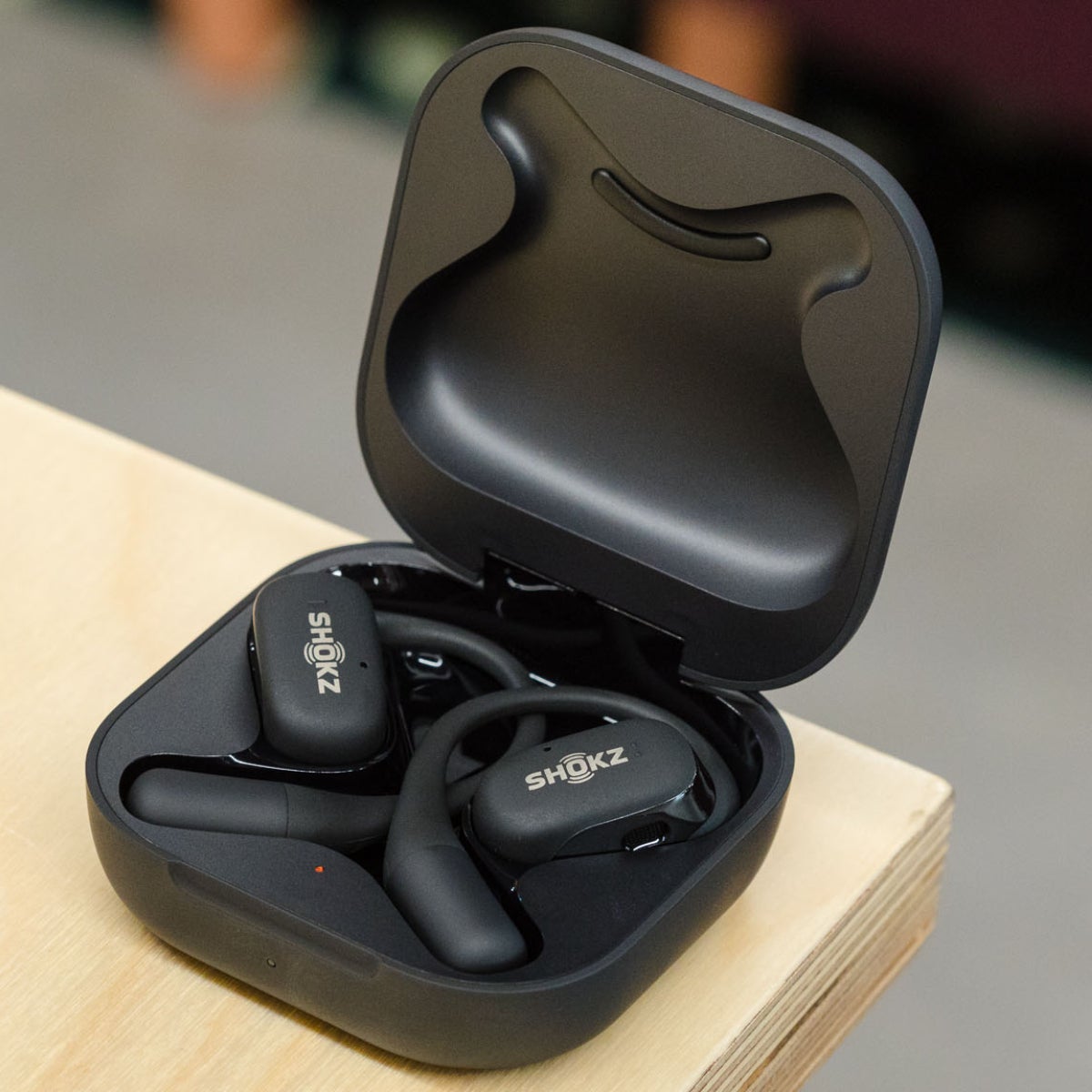

The OpenFit can be picked up in either Beige or the Black colourway reviewed here. Unlike conventional earbuds, the OpenFit don’t nestle into the contours of your ear, instead using ergonomic silicone hooks that tuck behind your ears to suspend a small speaker nodule over your ear canals. As well as maintaining a fairly solid grip, this design makes the OpenFit extremely comfortable to wear – indeed, with each earbud weighing 8.3g and there being no pressure on your ear canal, it’s very easy to forget you’re wearing them.
The charging case is less discreet, measuring 64 x 64 x 25mm (WDH) and weighing a relatively chunky 57g. This is larger than most true wireless earbuds cases, but not to the point where the OpenFit are a burden to fit in your pocket. The case doesn’t have any official waterproof rating but the buds are rated IP54, meaning they can handle a bit of rain and sweat. They’re no replacement for fully waterproof options like Shokz’ own OpenSwim (formerly Xtrainerz), however.
In-ear battery life clocks in at around seven hours when listening at 50% volume, with a further three full charges in the case bringing the total up to 28 hours. There’s no wireless charging, but five minutes on charge yields around an hour of listening time.
You can get accurate battery readings for both the earbuds and the charging case in the Shokz app. Here, you’ll also find a customisable five-band graphic equaliser, including Standard, Vocal, Bass Boost and Treble Boost presets, as well as customisation options for the touch controls.
By default, a double-tap on either earbud plays or pauses your music. This command is locked on the left bud but you can assign track skipping or voice assistant activation to the right bud instead should you wish. If you don’t tinker with the settings, pressing and holding the right bud skips to the next song, with the same action on the left bud skipping back a track. Again, you can change this in the app to incorporate volume adjustment or voice assistant controls if desired.
READ NEXT: Best running headphones
Shokz OpenFit review: What do they do well?
The OpenFit are the first Shokz headphones to use its proprietary “DirectPitch” technology, which channels the audio from 18 x 11mm dynamic drivers directly into your ear canals. The idea is that this enhances audio quality while minimising sound leakage. The latter proved hit and miss during testing but the technology delivers when it comes to audio performance.
Kicking off my shock-themed playlist with AC/DC’s “Thunderstruck”, I was treated to the OpenFit’s effective stereo separation; the right bud opened proceedings with a tight guitar riff, before the faint chanting, and eventually beating drums, joined in on both sides. By the time Brian Johnson’s lead vocals dropped in, a respectable, if not cavernous, soundstage had been established, with enough space to keep the crashing cymbals and whining guitars from bleeding into one another.
The instrument separation is most effective in tracks with a complex mid-section, such as Billy Idol’s “Shock To The System”. This rebellious anthem sees a peppy drum beat vying for attention alongside frantic guitars, energetic vocals and various sound effects, including a crackling livewire and police sirens. In a lesser mix, this song could easily get messy, but the OpenFit keep each element in check, presenting the track with all the structured anarchy of an organised riot.
Trebles can feel a little strangled on the standard sound profile, with the electric guitars in Metallica’s “Ride the Lightning” sounding dampened, in favour of more weight in the drums. While the Treble Boost preset did a reasonable job at countering this issue, I found that I had the most success when I opened a custom EQ and bumped the higher frequencies up a couple of notches.
Even with my custom tuning favouring the trebles, the lower end was not left out in the cold. “Electric Relaxation” by A Tribe Called Quest, for instance, has a fairly hefty bassline running through the track, and each beat hit with a satisfying sense of weight. Shokz attributes this to the OpenBass algorithm, which is designed to enhance lower frequencies. My time with the OpenFit gave me no reason to doubt this; even tracks that lean towards the brighter side of things managed to carry decent impact with their bass notes.
The OpenFit’s other strengths relate to their open-ear design, one which successfully achieves the goal of increasing awareness of your surroundings while the headphones are in use. This is invaluable if you’re running or cycling and can be useful when crossing the road or listening out for deliveries at home, too.
It’s also a design that makes the OpenFit extremely comfortable to wear. Normally, I’d want to build in breaks to give my ears a rest when testing earbuds, but this never felt necessary with the OpenFit. The battery on the end of the hook balances the speaker nicely, meaning that there’s never much pressure on the cartilage, reducing the likelihood of aches after extended listening. The hooks themselves are also low-profile enough that I was able to comfortably use them while wearing glasses.
And, of course, when you’re not putting things directly into your ear, you’re not introducing external bacteria, therefore reducing the chance of ear infections. For both hygiene and comfort, the OpenFit run rings around the rest of the true wireless earbuds market.