















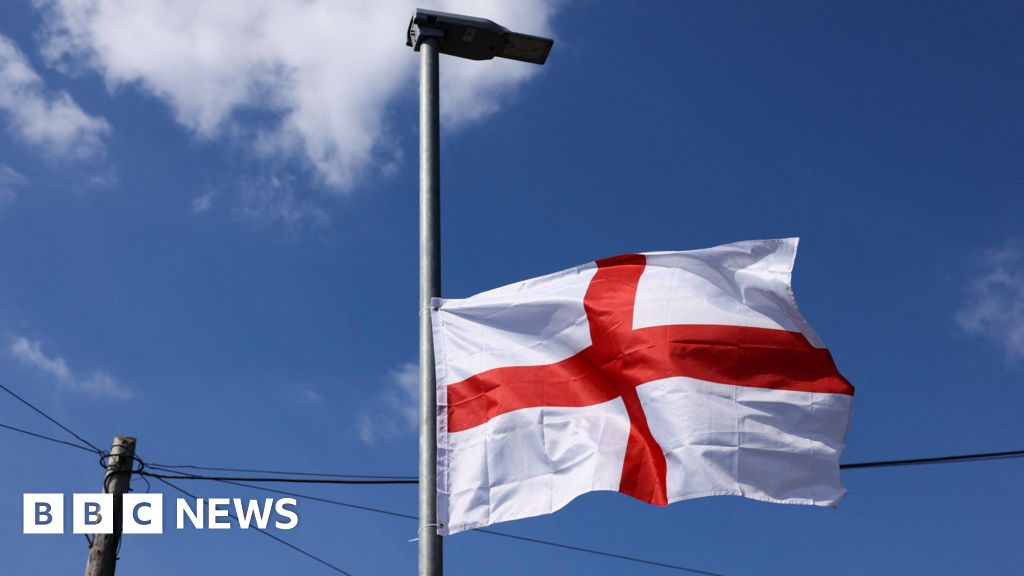

A council has said it will remove any flags that are judged to present a safety risk by being hung in inappropriate locations.
Sir Steve Houghton, leader of Barnsley Council, said flags fixed to public property or painted on roads would be taken away.
Union and Jack and St George’s flags on West Street in Hoyland were allegedly removed at the weekend, causing damage to the fabric, and red crosses painted on roundabouts were covered over.
Sir Steve did not confirm if the flags were removed by the council and stated that the authority was proud to fly national flags at the town hall, but stressed that using highways or public structures for displays was not acceptable.
“Regardless of how much we might love our flags, criminal damage and graffiti are not acceptable in any circumstances,” he said.
“I’m proud to be British and proud to be English. I’m proud that as a council we fly the Union Jack above the town hall every day of the year. The only exception to that is St George’s Day when we fly the St George Cross.
“Painting flags on the highway or hanging them from highway structures is dangerous, not just to the people doing it, but also for others passing by while they’re doing it. It then presents an ongoing health and safety risk to motorists and pedestrians.
“If people want to fly flags on their own property, that’s absolutely fine and up to them, but the use of the road network, council lamp-posts or other public property is not acceptable and these will be removed.”
St George’s flags grew in number as the Lionesses’ Euros campaign gathered pace in July.
Weeks later, the suburbs of Weoley Castle and Northfield in Birmingham had a mixture of the St George Cross and Union Jacks hanging from every lamp-post along several of their streets.
A group calling themselves the Weoley Warriors claimed responsibility, saying they were a “group of proud Englishmen with a common goal to show Birmingham and the rest of the country of how proud we are of our history, freedoms and achievements”.
The fact both flags have been used as emblems for far-right political movements meant some Birmingham residents were uncomfortable with the motivations of some of those backing the Weoley Warriors’ crusade.
The flags then started to appear on lamp-posts across the country.
A row broke out after Birmingham City Council said it was taking down the flags from lamp-posts due to safety issues
There’s been some confusion over this.
After seeing the flags going up rapidly across the city, Birmingham City Council issued a safety plea on 15 August to residents attaching them to lamp-posts and other street furniture, due to maintenance work being carried out.
A spokesperson said the authority was upgrading streetlights to energy-efficient LED lighting and had so far removed about 200 banners and flags from the streets of the city since the start of the year.
“People who attach unauthorised items to lamp-posts could be putting their lives and those of motorists and pedestrians at risk,” they said.
However, a number of people took to social media questioning the council’s reasoning for wanting to remove the flags.
There have also been questions over why a small number of Palestinian flags flown from lamp-posts were not taken down as well.
The city council later confirmed it had not removed any England flags during August.
Elsewhere, in Tower Hamlets, London, where flags were put up several days later, council workers were pictured taking some down, prompting fury in the community.
The suggestion flags would be taken down made a lot of people angry.
Rows of flags started appearing in other towns and villages overnight, including Bromsgrove and Worcester in Worcestershire, Bradford, Newcastle and Norwich.
The movement, fuelled by social media, has got a name – Operation Raise the Colours.
People have been pictured using cherry pickers and ladders to fly the flags as high as possible.
Joseph Moulton, from York, is co-founder of the national campaign Flag Force UK, which encourages people to submit instances of the flags appearing. He said the drive was about getting the country to unify under one flag.
More than £20,000 has been raised to support one campaign to put up flags in and around Birmingham, while more than 4,000 people have also signed a petition calling for the local authority to stop removing the flags.
Following the flying of hundreds of flags, red crosses started to appear on roundabouts in many parts of England
St George’s crosses have also been painted on roundabouts in Birmingham, Greater Manchester, Lincolnshire and Worcestershire, with a video of one man daubing the road in full view of a police officer.
West Mercia Police said it had started a criminal damage investigation over the painting of traffic islands, while West Midlands Police confirmed they were looking into the issue.