













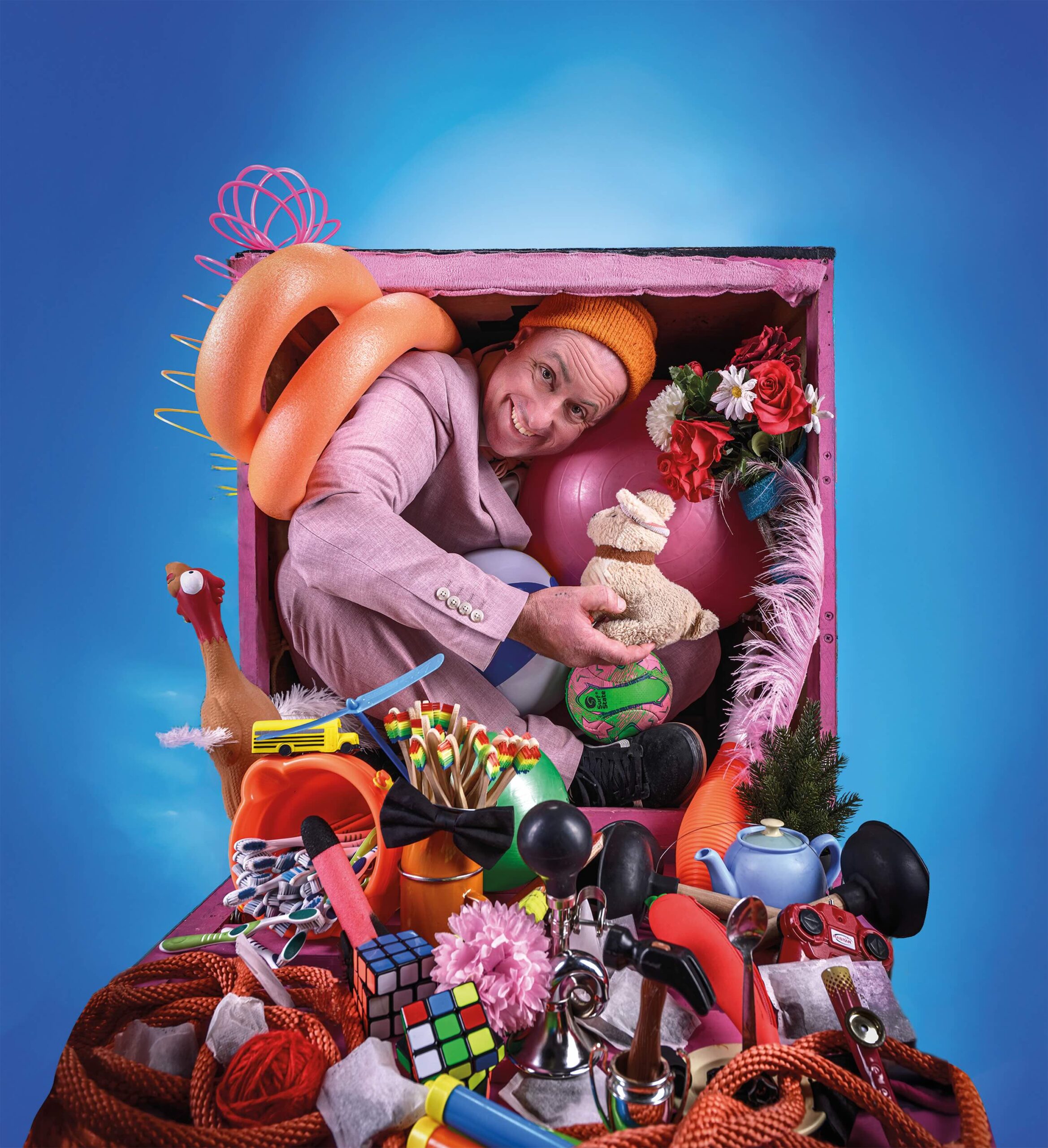
Audiences in Yorkshire are in for a treat this spring as award-winning visual comedian Darryl J Carrington brings his hit solo show Out of the Box to the region. The acclaimed silent clown and juggler will perform at Bingley Arts Centre on 7 March before heading to City Varieties Music Hall on 7 April and Guiseley Theatre on 8 April as part of his UK tour. Blending circus skills, physical comedy and playful audience interaction, Carrington’s joyful, wordless performance has captivated crowds around the world and was crowned Best Family Friendly Show at the 2025 Brighton Fringe. Packed with inventive tricks and infectious silliness, Out of the Box promises an evening of laughter for all ages when it arrives in Yorkshire.

Out of the Box turns everyday objects like toothbrushes and string into so much more that their intended function. What draws you to working with ordinary items, and how do you discover the magic hidden inside them?
Ive always loved the idea that objects and everyday items can have life of their own, the desk light from Pixar has always brought me so much joy.
I wanted to create a show of total unique tricks with props that wouldn’t normally be seen in the circus environment.
For me it harks back to the circus tradition of ordinary people doing extraordinary things, so I make ordinary objects do extraordinary things.
I often daydream and imagine what’s possible, and then take the prop into the rehearsal room and see what makes me laugh about it. But many of the ideas and routines, come from accidents or discoveries whilst onstage.
Music is also a massive part of my creative process, sometimes the prop comes first or sometimes I listen to s piece of music and a whole sketch comes to mind, music is such an incredible resource and is a massive part of the show.
I have a very cartoony imagination that basically never stops, but it basically comes down to play, I give myself permission to daydream and to be silly.
Your show is completely wordless, yet it connects across ages, languages, and cultures. What have you learned about humour and communication through working in silence?
When I used to talk on stage I always got lost in a train of thought and struggle to bring the audience along with me. When I stopped talking I found audiences focused more and if something random happened in the show, instead of explaining it away with words, I had to let it play out, which leads to so many funny moments which make each show feel unique for the crowd watching.
Ive always tried my hardest to do everything well, but it always goes wrong and people seemed to really enjoy me getting things wrong or seeing the rug get pulled from out from underneath me.
So instead of trying to cover it up I share it with them. I find people really relate to that.
No matter what your culture or language we’ve all had those days or times that we feel we must be in a prank show and look for the hidden camera.
Ive learnt to accept the fact that im a clown.
Also every audience is different and ive been so lucky to perform in so many different environments, from quiet streets in market towns, to comedy clubs, cabaret venues and even sold out arenas. Every audience is different and I love figuring out how to make people laugh and have fun in each different environment. Performing my show is a two way conversation with me and the audience, I never expect two audiences to be the same and the freedom from that expectation allows me to be present in the moment and to be as playful as possible.
Kindness and shared joy seem to sit at the heart of Out of the Box. How intentional is that philosophy in your work, and why does it feel important right now?
To be honest I never planned that, so its been a real pleasant surprise that thats the way its evolved.
I wanted to make a show filled with unique funny tricks, I love making people laugh.
But what I accidentally did was to create a show that rather than me focusing on the props and not dropping them, that I created a show that enabled me to really connect with my audience. Because the routines allow me to share what’s going on with the audience through eye contact and connection. I love audience participation shows, but I wanted my volunteers to feel like the stars of the show and not just be the butt of the jokes or stage hands.
I also don’t want anyone onstage that doest want to be there, so each participation routine has a consent mechanism built in, for example, I draw really bad characatures of my chosen voulentter nd in chalk on my box and if they don’t want to come and play then I choose someone else, its really important for me that people want t play and don’t feel forced to do so.
I also believe that finding your voice allows you to be the version of yourself on stage that the audience sees.
I always thought it was was some edgy provocateur, but it turns out im a gentle Buffoon 🙂
Im really enjoying performing a show thats just silly and fun, its an escape for an hour from everything that might be going on in peoples lives.
With over 20 years of experience in circus and clowning, how has your relationship with audience interaction evolved especially in family shows where anything can happen?
I learned that people want to trust you as a performer and if your audience can tell that your a master of your craft then they give you a license to push the boundaries and expectations.
Im always learning and the best clowns are the masters of their craft.
Tricks can also be a way of keeping the audience at arms length, in the same way an actor can hide behind a character or a script in the fourth wall.
Clowning is an amazing art and one that ive fallen into, rather than me presenting a series of tricks we go on a journey together. Being non verbal onstage means that my status is super low, so with every mistake or Random happening you discover ways to enhance the situation to get a laugh.
For example, I once had an amazing old veteran walkthrough the show in the street in Edinburgh he had a zimmer frame but a glint in his eye, I saluted him and then we proceeded to have a little dance to the samba music that was playing.
I believe there are no mistakes in clowning, every mistake or random happening is a gift and after so many years, you learn to trust your instinct on how to react.
I find working all over the world that different audiences react differently, so I learn how to communicate with them on their terms, for example in Finland audiences are very polite and hate making noises with their mouths but love to clap, so instead of getting them to make an oooohhhh sound, ill give them more time to applause after a routine.
The show has won major awards and five-star reviews, but it’s also described as “joyful mayhem.” How do you balance precision and chaos in a performance like this?
When im creating a show, I always build a trust me routine into the start of it so people know that im super high skilled in my field in this show its a juggling routine, I find this puts them at ease. I would never bring anyone on stage unless ive done something first, as they would have no idea what they might be letting them selves in for.
Each routine has a beginning and an end, but its a joy never knowing exactly what is going to happen in the middle and the more I do shows the more I love giving people who are joining me onstage and opportunity to be themselves.
The best clowns set up a premise and play second fiddle to their volunteer and thats a skill that takes a very longtime to learn, but is such an exciting journey!
But both the audience and myself clearly love it when things get very silly and out of control, so its about creating routines that allow people to be silly but in a safe and fun way.
And I think having adhd my mind can flit from one idea to another very quickly, and this is reflected in the music choices and length of routines. Nothing is formulaic and the show does have a narrative but its hard to predict. I also think this is why it also goes down so well in the send community, im not hiding my neuro diversity, more that ive found a way to unashamedly be myself and share that with others.
I’m naturally very chaotic, but have figured out systems on and off stage that contain the chaos so its fun to be around rather than a stress!
Beyond the tricks and surprises, what feeling or message do you most want families to carry with them after seeing Out of the Box?
You can try this at home!! I get wonderful messages from parents at a hardware store telling me that their kids have been sticking plungers to their heads, or that trying to throw tooth brushes into a cup has become part of the bedtime routine. Or dads that now regularly juggle footballs with their kids. The show is all about play being ageless and that we don’t ever have to stop being silly. That’s really why il love bringing the parents up to join in, its so great watching their kids sit in awe as they’ve learnt to juggle or make a cup of tea with their heads!
One of the things that also really warms my heart after the show is when adults of all ages tell me that they haven’t laughed that much in years! I love the idea that this is an adult friendly family show, everyones allowed to join in the laughter together across all generations.
But most importantly that there’s one language in the world that is truly international and thats laughter and I always thank the audience for sharing that language with me.