













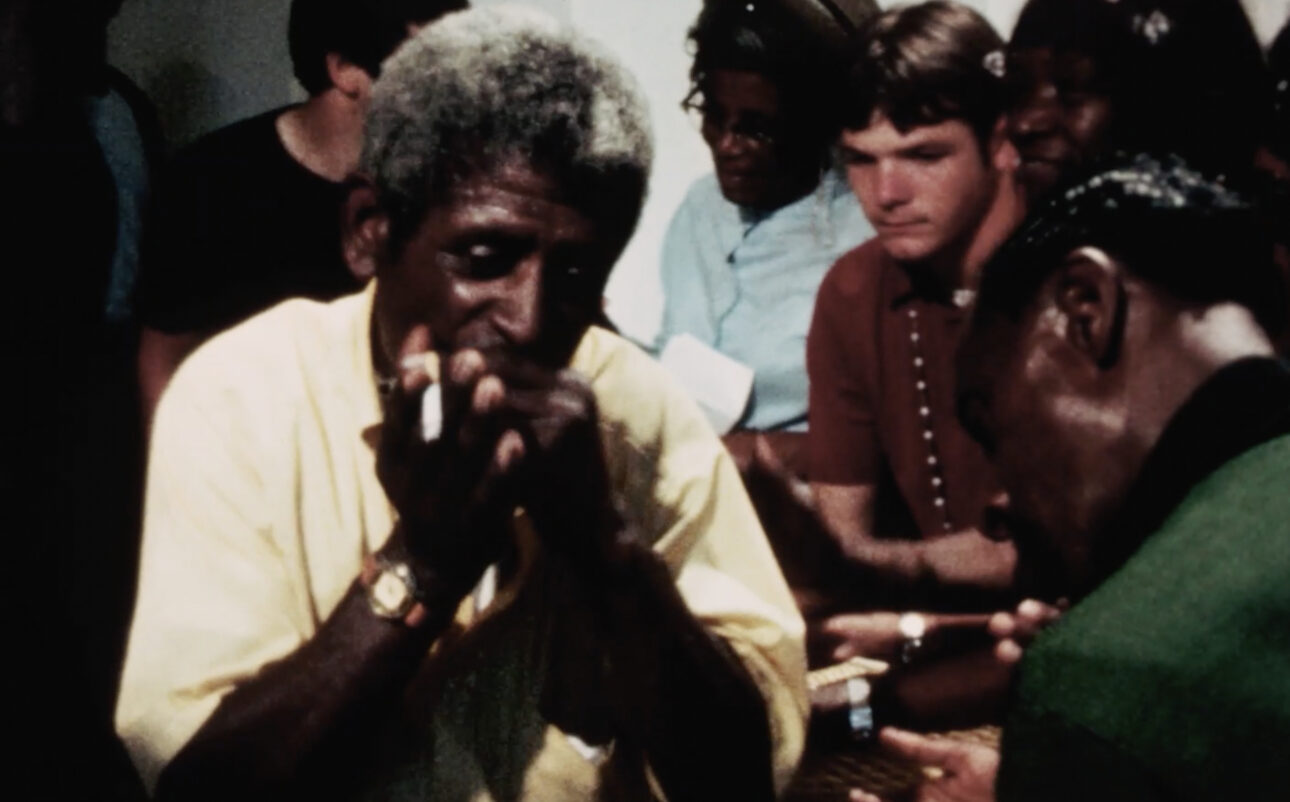

In the days before the first Memphis Country Blues Society festival in July 1966, some 400 members of the KKK marched at Overton Park, even burning a cross at the parking lot. That didn’t stop the festival organizers, performers, and audiences—white and Black, old and young—from gathering at the Shell to celebrate the city’s blues heritage. The event featured Furry Lewis, Bukka White, Piano Red, and Mississippi Fred McDowell, among others. It was enough of a success that they immediately began planning the next one.
Those two very different events show just how divided Memphis was in the 1960s and how the blues, developed and notated down on Beale Street, would continue to be a lightning rod, as would the festival itself. That march is an early pivotal moment in Augusta Palmer’s new documentary, The Blues Society, which she calls a “moving-image mixtape.” The film, which hits streaming this week, chronicles the short run of the Memphis Country Blues Society Festival, which took place every summer from 1966 through 1969. It played out against dire moments in local and national history, defined by the passing of the Civil Rights Act in 1964, the Sanitation Workers Strike in 1968, and the assassination of Martin Luther King Jr. later that year. Even as the city was divided along racial lines, Black and white performers and fans met at the Overton Shell to create and enjoy country blues.
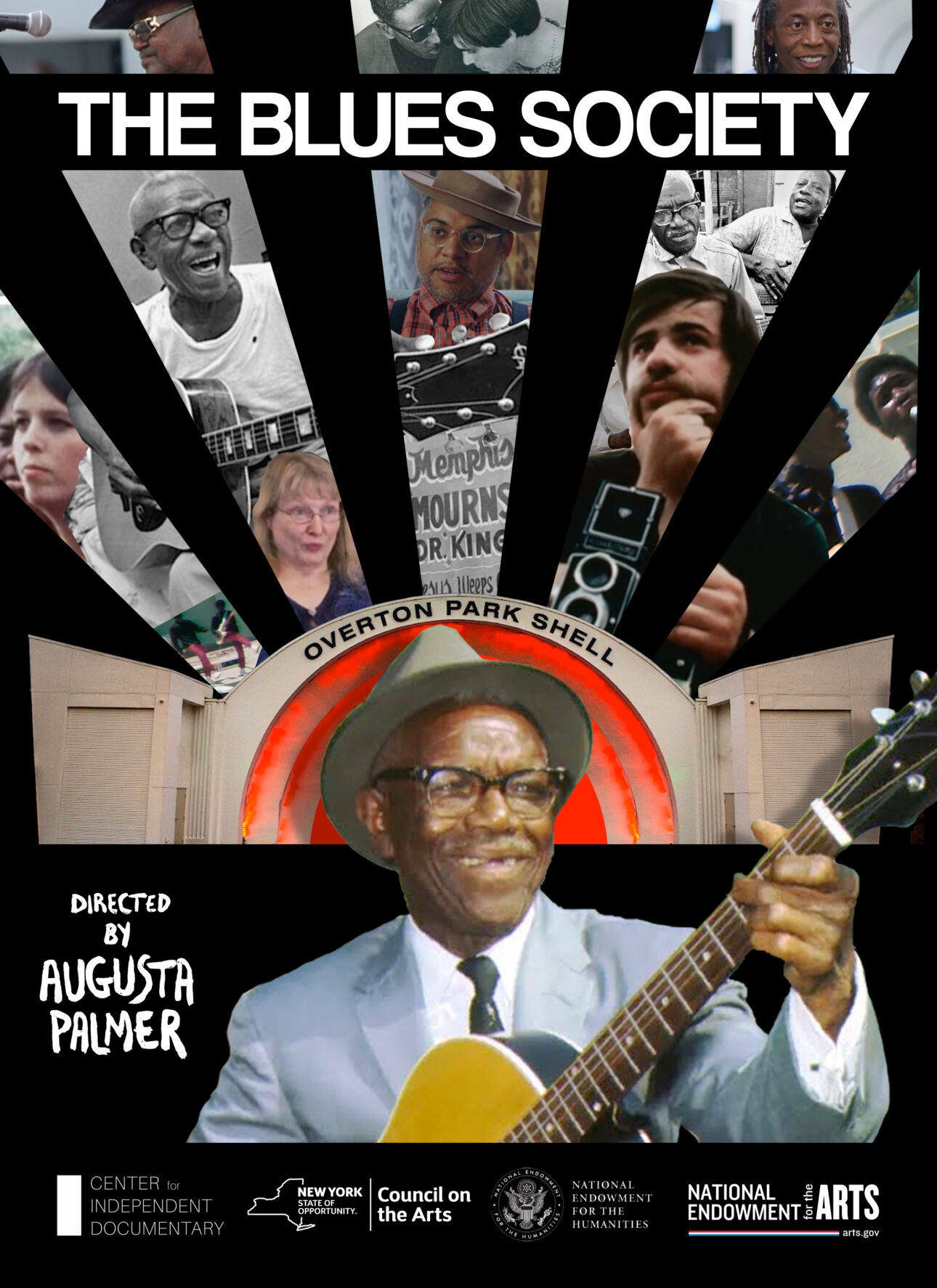
The festival was the brainchild of a pack of white Memphis hipsters, including famed producer/sideman Jim Dickinson, singer Nancy Jeffries (from a local band called the Insect Trust), and critic/musician Robert Palmer—who is Augusta’s father. Heavily influenced by local country blues, they wanted to provide a platform for musicians whose accomplishments and innovations had been largely overlooked, within the city and well beyond its limits. Featuring Lewis and Estes along with the Rev. Robert Wilkins, Nathan Beauregard, and Mud Boy & the Neutrons, the festival attracted national and international attention, but fizzled out after 1969, thanks in part to the city’s meddling.

Speaking with a range of voices—including original organizers and performers, along with younger musicians and writers—Palmer shows how the organizers’ best intentions were complicated by their own often paternalistic relationship with the Black artists they wanted to celebrate. “There was always a danger of making a Black artist into a symbol,” Palmer tells SPIN. “Even though there was a lot of love and appreciation for the music and the musicians, if somebody is making you into a symbol, you lose your humanity on a level—on a very clear, individual, visceral level.”
At times joyful and outraged, it’s a fascinating story, and the mixtape format allows Palmer to explore different aspects of these events, how they both challenged and buttressed certain ideas about blues music and the people who play it. In that regard, The Blues Society plays well alongside Max’s recent four-part history of Stax Records, which covers this same moment in Memphis history, albeit not the same music scene. It’s also a fine companion piece to the 2019 concert film Memphis ’69, which covers only one year of the festival.

It’s not criticism to say that The Blues Society is best when there’s a performing musician on screen rather than a talking head. Then as now, these players remain obscure but exciting and influential. Lewis is deeply charismatic, even subversive in his humor, hiding his face in his hands after cracking an off-color joke or bouncing his way through “Let Me Call You Sweetheart.” Wilkins and his family lock into a sharp groove. The revamped Bar-Kays, just months after losing most of their original members to the same plane crash that killed Otis Redding, deliver an energetic, almost frantic performance in 100-degree heat, then have to do it again for the cameras.
Ahead of its streaming release, Palmer hoped on Zoom to discuss the origins of the film, the nature of Memphis music, and what it was like working with footage of her parents.
Was there a moment when you realized, Oh, I’m working on a documentary about the Memphis Country Blues Society now? How did the film start?
Augusta Palmer: I was told there was some footage available, which is the footage that Fat Possum made into Memphis ’69. It had been shot by a guy named Gene Rosenthal. In 2013 I went to look and listen to that footage, which hadn’t been synched at that point. It had been in a basement for a long time. When I walked in, Gene was playing a speech my mom had given at the festival, which made it into the film. She’s asking people to please pay for their tickets. So I was pretty hooked at that point. Just to hear her voice… I had never heard her talk about the events, so it gave me a different perspective on how much of a collective effort it was.
When I was making the film, I heard from people who said the festivals were important because of the people who put them on, like my dad and Jim Dickinson. But I think my dad and Jim and Nancy would say the festivals made them more than they made the festivals. They knew they were part of a group of people coming together to do something. Being able to spend time with Furry Lewis and Robert Wilkins and all those people was tremendously important to the organizers, but they wanted those people to be center stage.

It was like they were still working out their relationship to these people. There’s that scene where a woman is holding an umbrella for one of the performers, and there’s a lot to unpack in that image of them onstage together.
I remember talking with [Memphis historian/filmmaker] Jamey Hatley about what she saw in that image. She didn’t articulate it exactly this way, but there was a kind of privilege in the way these white organizers were occupying that space. They could say, Hey! I’m upending society. But then they could just walk off and have a Coke. I’m overstating it, of course. There were consequences. My dad and a guy named Bill Barth were put in jail in Mississippi when they went to find Joe Callicott. But their consequences weren’t the same consequences the Black players had been suffering their whole lives. Jamey saw that danger and difficulty even in that moment with the umbrella. There was always a danger of making a Black artist like Bukka White or Nathan Beauregard into a symbol. Even though there was a lot of love and appreciation for the music and the musicians, if somebody is making you into a symbol, you lose your humanity on a level—on a very clear, individual, visceral level.
Memphis is often discussed as a racial utopia, largely because white guys could go to Black clubs and thought they were breaking down a barrier. But a Black person would not have that same access to a white club.
It’s like the Stax story. Stax has been presented as this place where Black and white artists collaborated equally. There was some amazing music made there. There’s no doubt about that. But I’m sure that different people had different feelings about those moments based on their race and their experiences.
You call the film a “moving-image mixtape,” which is an interesting phrase. Where did that come from?
Whenever you’re writing something or making a film, the beginning is so important. But it can be difficult to know where to start. Every once in a while something will burst forth fully formed, and you know exactly where to stay. Finding the right beginning for this film was very difficult. When I showed a previous cut, one of my advisers said we need to know that this is not your average blues film, whatever that might be. It’s something different. I just started thinking about it as a mixtape.
Plus, my dad had given me this mixtape back in the ‘80s that was called “The Real ‘60s, Man,” and one of the things he had written on one side was that this was the real ‘60s, not the ‘80s ‘60s. On the other side were these trippy Beatles covers by Sonic Youth and Bongwater. That made me think that history is always selective. It was the first time I understood that you couldn’t see the ‘60s exactly as they were. I saw them a different way in the ‘80s, and I saw them a different way in 2016 when I started making the film.
What was it like working with footage of your parents?
I worked on the film for a long time, so maybe that made it less emotional. Of course, my mom isn’t actually seen in any of the footage because she was taking tickets. I guess that wasn’t very exciting for the people filming. But it’s always sweet to see my dad as this very young guy because I actually didn’t grow up knowing him. I didn’t get to know him until I was a teenager.

What were some of the challenges of working with this archival footage? Was there one year in particular that was not well represented?
The challenge was how to tell a story that goes from 1966 to 1969. There was a lot of footage from 1969—the Gene Rosenthal footage. There was also some footage shot by WNET, the New York PBS station, and the Steve Allen Show did a Sounds of Summer segment. That was also shot in 1969. I was always more interested in the broader four-year story of the festival, which starts with the organizers funding it with $65 and a baseball-size chunk of hash [and building it into] an event that attracts these film and TV crews. There was a record made in 1968. I was interested in the idea that in a short amount of time you could go from something very small and maybe a little disorganized to something that people are paying attention to on the coasts.
I knew there was to be more footage out there. I’m still waiting. I feel like it has to appear really soon. I’ve heard legends but have never been able to find it. But I was given this mixtape that had been made from a reel-to-reel labeled “1969 Memphis Country Blues Festival.” The person had transferred the reel-to-reel to DAT and then got rid of it. I didn’t have a DAT player, and I already had so much footage from 1969 that I didn’t play it for a while. When I finally listened to it, it turned out that the tape was from 1966. There was almost nothing from that first fest, so it was very cool to have heard words and music from that year.
How did the festival fall apart?
Like anything else, if somebody starts to make money from it, you tend to get some actors on the scene who are not necessarily honorable. That happened generally. And rock ‘n’ roll had taken the blues and made millions off of it without always acknowledging the pioneers who created that music. But in Memphis specifically, because Martin Luther King had been murdered there in 1968, the city was really looking for any good press. So they got involved with the festival in 1969. You can see that moment as the city recognizing that the blues can be good PR for them and taking advantage of that. Sadly, that’s led to things like making Beale Street what it is now—the Epcot Center-ization of the blues. And even though I love Stax and the Stax Museum and I’m so glad it’s there, it just seems so Memphis to have had this cultural landmark demolished and then a perfect replica [rebuilt] on the same site. It’s bringing back the history, but it’s also erasing that intermediary history where people weren’t really realizing how important and wonderful that music at Stax was and is.
When the city books Johnny Winters to play in ’69, it definitely seems like it’s part of a large pattern of meddling.
I feel like Johnny Winters gets a lot of crap in the film, but it’s really more what he represents than what I think of him. This is a festival that’s meant to celebrate Memphis blues, so why bring in somebody who’s a contemporary recording artist from Texas? But I will point out that the city also invited the blues luminary Marguerite Piazza to play the blues festival, so it could have been much worse.
What was the impact of the festival on people like Furry Lewis?
I guess it’s hard to quantify exactly. Before the festival a lot of these players were at the Newport Folk Festival, and there’d been a book by Samuel Charters called Country Blues, with a record accompanying it. So I think these players were going to get more attention, but I do think the festival furthered their fame outside of Memphis. Furry went on to essentially play himself in a Burt Reynolds movie called W.W. and the Dixie Dancekings. And he was on Johnny Carson, where he famously said, Why do I need a wife if my neighbor’s got one? I’ve been lucky enough to show the film to some high school students, and it’s pretty new to them to hear Furry.
What is their reaction to him?
I think in terms of people my age or my parents’ age, the demographic of blues fans is very heavily skewed male. But when I’ve shown it to younger people, it’s usually the girls who are more interested in it and open to it. I think they’d heard about the blues but maybe had heard blues. Once they did hear it, they were pretty interested and wanted to hear more.